


Nearly two out of three American homeowners have put off a repair because they couldn’t afford it. Clever Real Estate’s March 2026 homeownership survey put that figure at 63 percent, and it says something true about how houses work. Problems don’t wait for your bank account. They show up on a Tuesday, usually during a heat wave or a storm, with a price tag attached. I’ve bought houses from people on every side of that moment, and the pattern holds: expensive home repairs rarely give you enough warning to plan around them.
What Are the Most Expensive Home Repairs Homeowners Face?
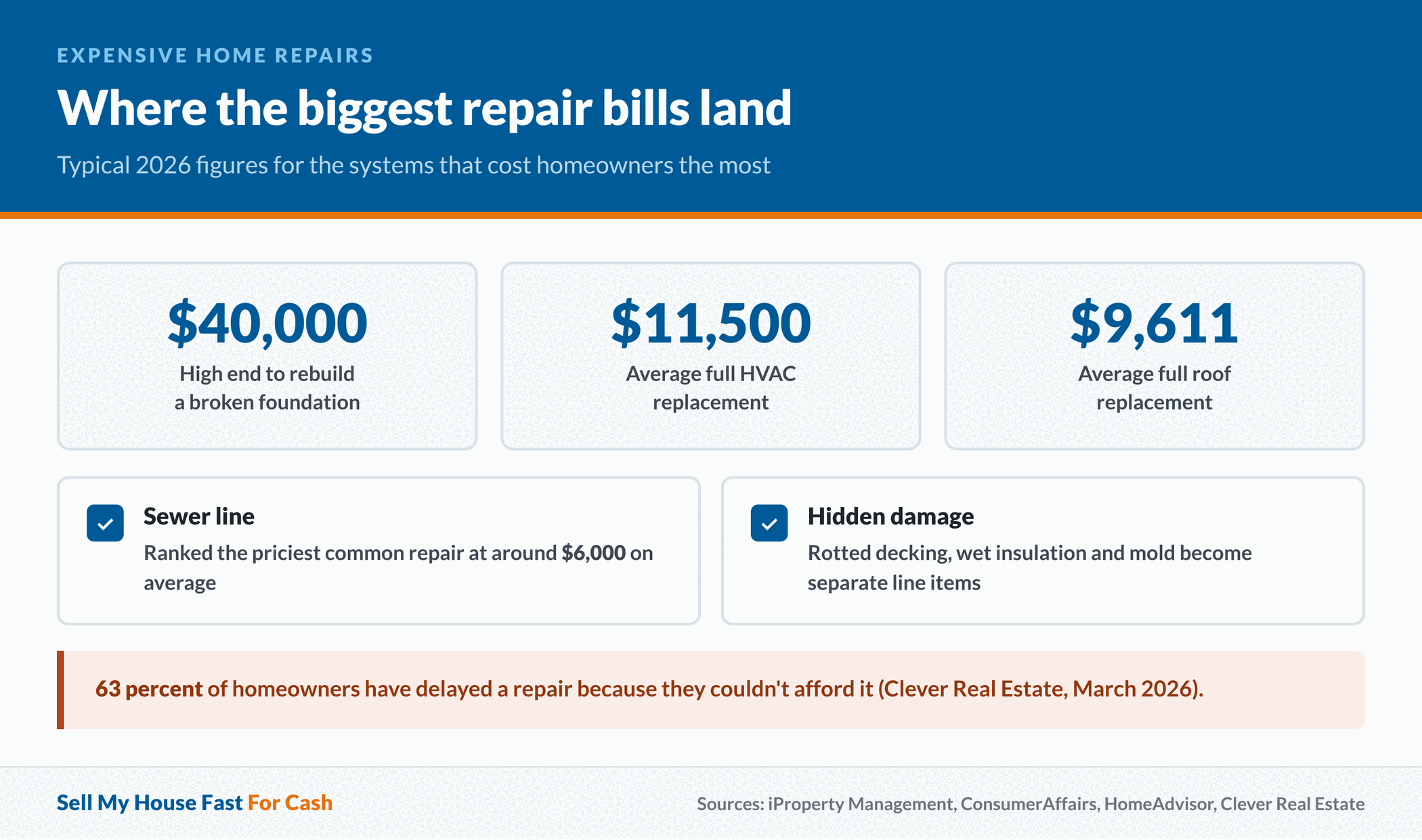
Forty thousand dollars is the high end for rebuilding a broken foundation, according to iProperty Management’s 2026 repair cost research. The same research ranks sewer line work as the priciest common repair, at around $6,000 on average. Those two sit at the top of almost every repair list I’ve seen, though replacing a whole roof or HVAC system can cost more.
Right below them, the field gets crowded. Think roofs, HVAC equipment, electrical systems, and mold remediation after a long water leak. Any one of these expensive home repairs can eat a year of savings.
Access is usually what separates ordinary maintenance from the truly expensive home repairs. A plumber replacing a faucet works in open air. A plumber replacing a sewer line under your driveway has to dig, haul away soil, and work around utility markings, then restore the concrete once the pipe work is done.
Early last year I got a call from an heir in Dubuque, Iowa, who’d inherited her aunt’s 1950s ranch from four states away. A contractor walked the kitchen on a Saturday and handed her an estimate. It came in higher than the finished kitchen would add to the property, mostly because the subfloor had rotted under a decades-old dishwasher leak. She sold as-is instead and never set foot in Iowa.
Age drives the rest. Homes built before 1980 often have aluminum wiring, cast iron drains, and galvanized supply pipes that all wear out around the same decade. Fixing one tends to expose the next. That’s how a single inspection finding turns into four quotes.
Why Does a Leaking Roof Cost So Much to Repair?
For years I assumed a roof leak was a shingle problem, and I priced it that way when I made offers. I was wrong. Water gets in at a shingle, travels along the decking, and ends up somewhere entirely different from where it started.
HomeAdvisor puts the average full roof replacement at $9,611, but that figure only covers what a roofer touches. Rotted decking, soaked insulation, stained drywall, and mold growth in the attic all become separate line items, handled by separate trades.
Moisture is patient. A slow water leak can run for two or three seasons before a ceiling stain appears, and by then the damage has spread sideways through framing you can’t see without cutting into it.
Have you been up in your attic lately? I mean the actual space, not just the hatch. Look for daylight through the decking, dark streaks on rafters, and insulation that feels heavier than it should. Checking costs nothing, and it’ll tell you more than any sales pitch from a storm-chasing roofer.
Insurance makes this harder. Most policies cover sudden damage, like a tree limb punching through after a windstorm. They exclude gradual wear. If an adjuster decides your roof simply aged out, you’re holding the full bill, which is how roof work ends up among the expensive home repairs for so many families.
Labor hours climb with a steep pitch, multiple dormers, and layers of old shingles. Two houses on the same block with identical square footage can be thousands apart on a quote, since it comes down to how long a crew spends on the slope.
What Makes Foundation Repairs So Costly?
A widow in Bend, Oregon, called me about a crack in her garage slab she’d been watching for three years. By the time an engineer looked at it, the doors upstairs wouldn’t latch and the quote involved piers.
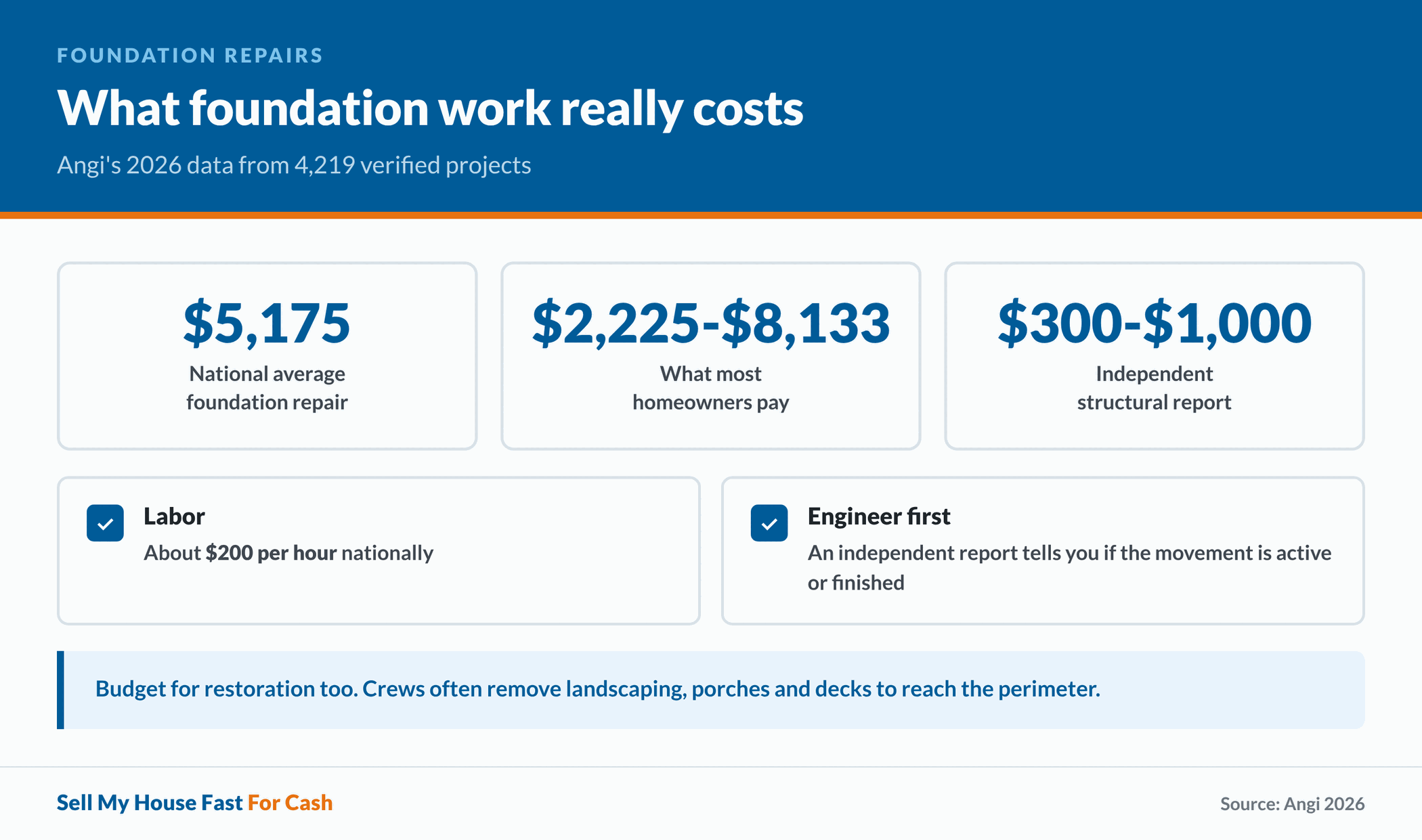
Angi’s 2026 data, drawn from 4,219 verified projects, puts the national average foundation repair at $5,175, with most homeowners paying between $2,225 and $8,133. Labor alone runs about $200 per hour nationally. An independent structural report costs $300 to $1,000 if you want a second opinion before comparing bids, and you can read the full breakdown in Angi’s foundation repair cost guide.
Soil does the damage. Expansive clay swells when wet and shrinks when dry, lifting and dropping sections of your house on a seasonal cycle that never stops.
Pay for the engineer’s report before you call a single repair contractor. A company that sells piers will find a reason to install piers, and that isn’t dishonesty so much as the tool they own. An independent evaluation tells you whether the movement is active or finished. A settled foundation that stopped moving a decade ago may need nothing beyond cosmetic patching.
Foundation work also tears up everything around it. Crews remove landscaping, porches, and sometimes decks to reach the perimeter, and then you pay again to put the yard back. Homeowners rarely see that restoration cost in the headline number they remember.
Buyers are tough on foundation disclosures. That’s why these expensive home repairs hurt twice, first at the contractor’s invoice and again at the negotiating table when a retail buyer’s lender wants an engineer’s letter before closing.
How Much Does It Cost to Repair a Sewer Line?
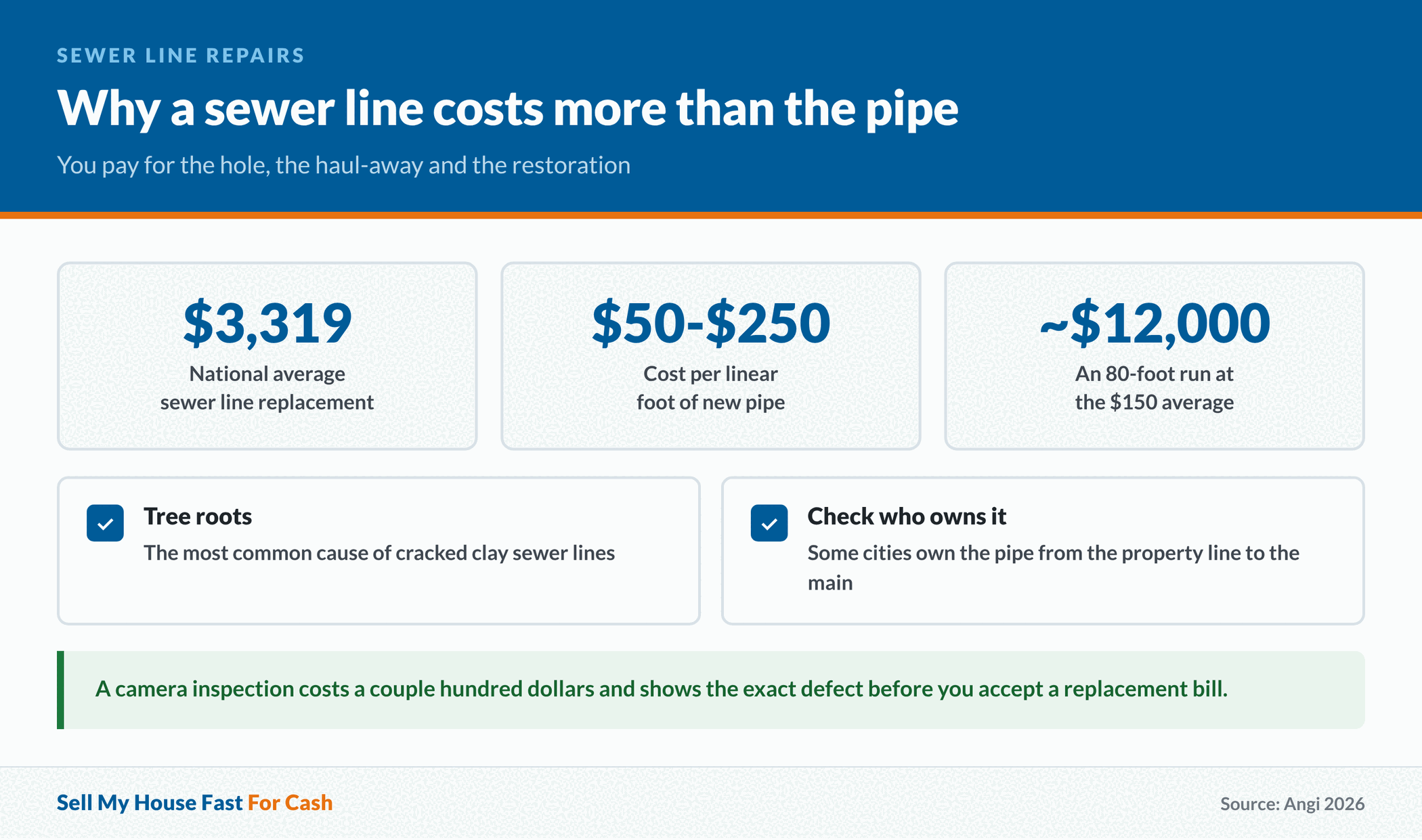
You might argue that a sewer line is just a pipe, and pipe is cheap. That’s true until you price the hole. Angi’s 2026 figures show a national average of $3,319 for sewer line replacement, with most homeowners paying between $1,388 and $5,323. New pipe costs $50 to $250 per linear foot and averages around $150 with materials and labor, which you can verify through Angi’s sewer line replacement data.
Run the math on your own lot. A house set 80 feet back from the street, at that average per-foot rate, lands near $12,000 before anyone repours the driveway.
Tree roots cause most of what I see. They find a hairline gap in a clay joint, grow toward the warm, nutrient-rich flow, and keep expanding until the pipe cracks open.
Camera inspections changed this corner of expensive home repairs for the better. For a couple hundred dollars, a plumber runs a scope down your cleanout and shows you video of the exact defect. I’ve ordered one on nearly every older property I buy. If you’ve got recurring slow drains, I’d do the same before accepting a replacement quote.
Trenchless methods spare your yard and driveway, but they aren’t always possible. A fully collapsed line needs digging no matter what the marketing says. Some towns own the pipe from the property line to the main, while others push that burden onto you, so who pays varies a lot by city. Your local water or public works department can tell you exactly where their responsibility ends. That one phone call has kept sellers I’ve worked with from paying for city-owned pipe.
Why Is Replacing a Heating or Cooling System So Expensive?
A neighbor down the street learned this the hard way when her furnace quit during a January cold snap and she got stuck with emergency pricing. Guess wrong on the age of your heating and cooling systems and you’ll end up paying premium rates in the worst week of the year. Full HVAC replacement runs between $3,000 and $40,000, with most homeowners paying $8,000 to $15,000 and an average near $11,500 in 2026, per ConsumerAffairs.
Refrigerant rules pushed those numbers up. The industry’s shift to A2L refrigerants like R-454B has made units more expensive to build and service, so the equipment itself costs more than it did three years ago.
Homeowners lose money when they keep pouring repair dollars into dying HVAC equipment. A common guideline says that if your system is more than 12 years old and the repair quote tops $1,500, replacement makes more sense.
Ventilation and ductwork add another layer. If a contractor finds undersized or leaking ducts, they have to fix them, or your brand-new condenser will underperform and your utility bills will stay high.
Insurance helps less than people hope. Homeowners insurance generally excludes HVAC replacement because upkeep counts as the owner’s responsibility, though a policy may pay if a covered disaster destroyed the system. I’ve seen buyers assume a repair was covered and get a flat denial. Read your own policy language first, because these expensive home repairs often fall outside what insurance pays altogether.
Preventive maintenance really works here, and I don’t say that about every piece of advice in the home maintenance world. Tune-ups averaging around $100 per visit extend equipment life and can push a five-figure replacement out by several years.
How Do You Budget for Sudden Expensive Home Repairs?
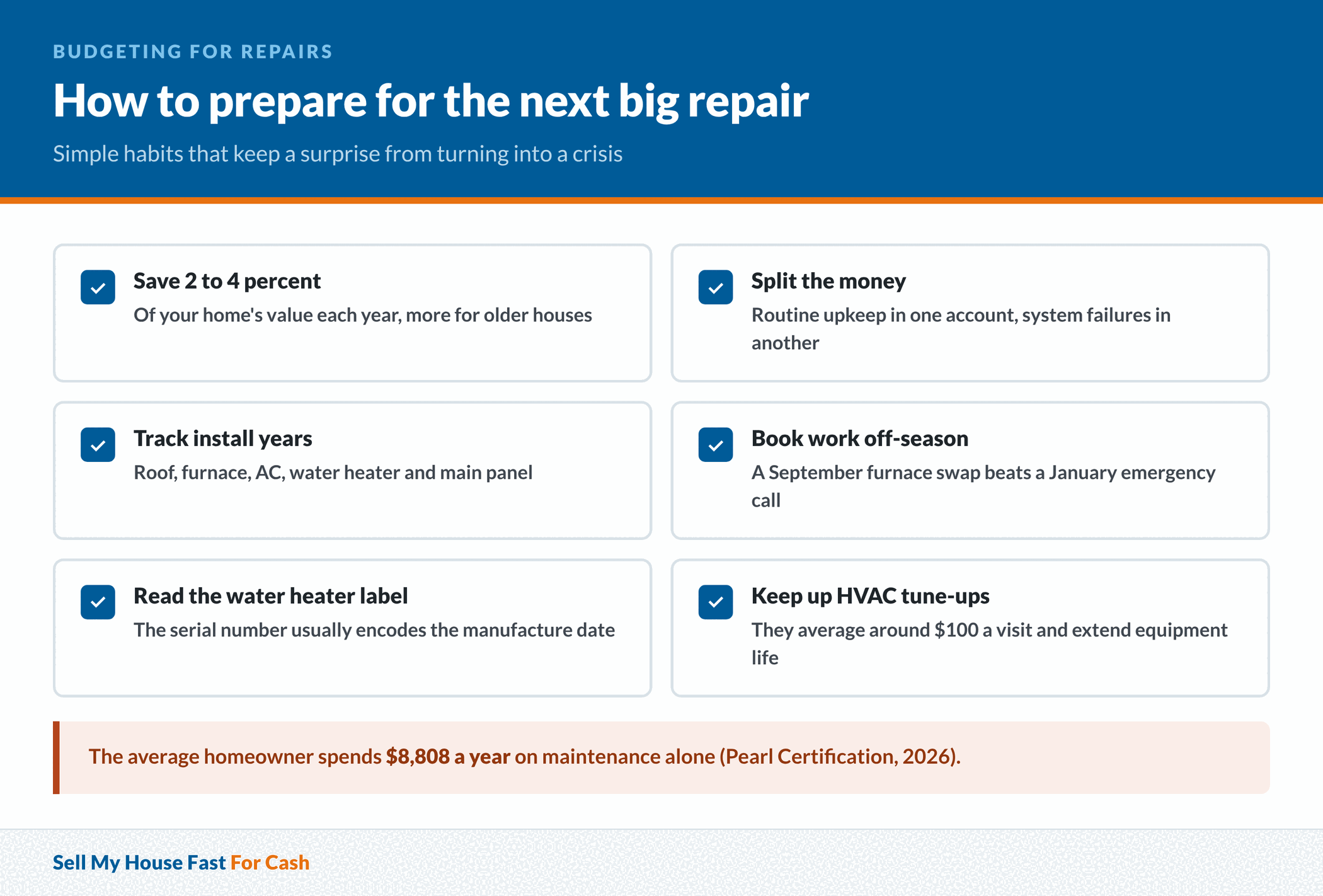
The old one percent rule is outdated, and plenty of homeowners still budget by it. Pearl Certification’s 2026 report found the average homeowner spends $8,808 a year on maintenance alone. That’s more than double what the one percent guideline suggests for a median-priced home.
Set your reserve as a percentage of your home’s value, not a flat dollar figure. A more realistic 2026 benchmark is 2 to 4 percent of value annually, and older houses sit at the top of that range.
Keep the money in separate places. Routine upkeep (gutters, filters, pest treatment) goes in one bucket, while catastrophic system failure belongs in another account you don’t touch. Deferred repairs now average more than $5,600 by the time they finally get done, and that’s the real cost of waiting.
Homeowners often underestimate how much timing matters with expensive home repairs. A furnace replacement scheduled in September beats one scheduled in January, because contractors price emergency winter calls to match.
Do you know how old your water heater is? The manufacture date is usually encoded in the serial number on the label. Ten minutes of searching gives you a planning horizon instead of a surprise flood.
Write down the install year of every major system, including the roof, furnace, air conditioning, water heater, and main panel. Tape that list inside a cabinet door. When three items cluster in the same five-year window, you’ll see the wave coming and can stagger the work on purpose instead of reacting to failures.
In my experience, home warranties are a mixed bag. They cover some plumbing repair and appliance failures. Their exclusions for pre-existing conditions and improper maintenance, though, give companies room to deny exactly the claims homeowners count on.
How Can You Avoid the Stress of Expensive Home Repairs?
Sometimes the right answer is to stop fixing the house. Thirty-eight percent of homeowners don’t budget for unexpected repairs at all, and for people in that group, one failed system can start a spiral that drags in credit cards and retirement accounts.
Annual inspections catch problems while they’re still small. A home inspector charges a few hundred dollars to walk your property with fresh eyes. I’ve watched that one expense prevent water damage running into five figures.
Cheap habits pay off. Clean the gutters so water leaves the roofline instead of pooling at the foundation, and grade soil away from the house. Trim tree limbs before they reach the shingles, and check the yard after heavy rain for standing water near the slab.
Small signals matter more than any insurance product. A faint musty smell in a closet means moisture somewhere. A breaker that keeps tripping means an electrical problem, not a nuisance.
Selling as-is is a legitimate financial decision, not a surrender. When the combined quotes approach a meaningful share of what the property would fetch repaired, repairing stops making sense. Our team at Sell My House Fast For Cash buys houses in their current condition, which takes the repair question off the table entirely.
Safety limits should override budget every time. Gas smells, scorched outlets, and sagging structural members aren’t projects to put off until spring, no matter what else is competing for your money that month.
Who Can Help You Handle Expensive Home Repairs?
A landlord in Ocala, Florida, once came to me with a vacant duplex, a failed septic system, and mold growth a tenant had left behind the washer. Three weeks later we closed, and he never hired a contractor or spent a dime on repairs.
Build your bench before expensive home repairs show up. A licensed general contractor, an independent home inspector, a structural engineer, and an insurance agent who answers email promptly will each save you money at different moments.
With expensive home repairs, get three bids on anything over a few thousand dollars, and compare scope rather than price. If one roofer’s number includes decking replacement and the other’s doesn’t, the cheaper quote often isn’t cheaper.
Local nonprofit and government programs exist for homeowners who qualify, and too few people use them. USDA, HUD-funded local agencies, and area aging services sometimes pay for roof and accessibility work for income-eligible owners. Eligibility rules differ by state and by county, so your local housing authority is the office that can confirm what you’d qualify for.
A man called me one weekday afternoon from Chesapeake, Virginia, sitting in his truck in a parking lot. He and his wife were dividing assets. Their house had a cracked heat exchanger and a basement that smelled like a pond. He told me plainly that he didn’t want to manage contractors through a divorce, and I understood. Nobody wants a repair punch list on top of that kind of paperwork. We closed on a date they both picked, and he kept the tools in his garage.
For sellers in that spot, a direct buyer takes on the repair burden instead of handing it back. We’re happy to talk if your property needs work you can’t fund. An as-is offer prices the condition honestly instead of asking you to borrow against it first.
Frequently Asked Questions
What Is the Single Costliest Repair a House Can Need?
Structural foundation work has the highest cost ceiling, since rebuilding a failed foundation reaches into the tens of thousands and sometimes far past that. Sewer line repair still tops iProperty Management’s average cost ranking, because nearly every older home eventually needs that pipe addressed, while only some homes develop serious settlement. Both share the same driver. Crews have to dig to reach the problem, and digging plus restoration is where the money goes.
How Much Should You Set Aside Each Year for Home Repairs?
For expensive home repairs, use a percentage of your home’s current value instead of a fixed dollar amount. Lean toward the higher end of the range above if your house has passed the twenty-year mark. Keep routine upkeep money separate from your emergency reserve so a single failure doesn’t wipe out both. If you’ve been putting work off, add extra until you’ve caught up on the backlog.
Does Homeowners Insurance Cover Expensive Home Repairs?
Insurance pays for sudden, accidental events, not wear and tear. A burst pipe is usually covered, and a pipe that corroded over twenty years usually isn’t. Read your declarations page and your exclusions before an emergency, and ask your agent specifically about water backup and equipment breakdown endorsements. Those add-ons are inexpensive, and they close gaps that catch plenty of families.
Should You Fix Major Problems Before Selling?
Not always, and I’d push back on the standard advice that every house needs repairs first. Retail buyers do expect a home in reasonable shape. Still, if the quotes for expensive home repairs eat most of the value those repairs would add, you’re spending money to break even. An as-is sale to a direct buyer skips the contractor cycle and still produces a fair offer based on current condition.
Can You Negotiate Repair Costs with a Contractor?
You can, and with expensive home repairs, negotiating scope works better than negotiating price. Ask what the quote would look like with a different material, a phased timeline, or a slower off-season schedule. Contractors protect their hourly rate. They’ll often adjust the plan, though, and three written bids give you honest leverage without anyone feeling squeezed.
Repair Costs and Selling in the Seattle Area
Repair bills hit harder when buyers have more homes to pick from. Northwest MLS reported that active listings in its Washington counties were up more than 25% in October 2026 from a year earlier, while pending sales fell nearly 18%. With that much choice, a lot of buyers pass on a house that needs a new roof or sewer line. If that sounds like your place, our team of cash home buyers in Seattle can make an offer on it as it sits today. We also buy houses in Tacoma, Everett and Kent.
Get an As-Is Offer on Your House
Maybe your house is facing repairs you’d rather not take on, or you’re just trying to figure out whether fixing or selling makes more financial sense. Either way, we’re glad to talk it through. There’s no pressure or obligation, and no hard feelings if you decide to keep the house and tackle it yourself.
Contact us with a few details about the house, or send them through the form below.
Helpful Blog Articles
- Selling a House to a Family Member
- Selling a House With a Child Support Lien
- For Sale By Owner Benefits
- Can You Sell A House As Is Without An Inspection
- How to Find a Realtor in Another State
- Should You Replace Your Roof Before Selling Your House
- How to Avoid Capital Gains Tax When Selling Your House
- How to Sell a House with a Reverse Mortgage
- How to Sell a House While Living in It
- What Are the Most Expensive Home Repairs
