

Dinner at six, showing at six-fifteen. One seller I worked with last spring had a Tuesday like that, and she kept a laundry basket in her trunk for three straight weeks just to clear the bathroom counters fast. Most people picture a sale as something that happens to an empty house, but real life looks different. The vast majority of homes on the market right now have somebody sleeping in them, eating in them, and dragging the trash to the curb on schedule. If you want to sell while living in the place, you’re in very ordinary company.
This article covers both versions of that idea. One is selling a house you still occupy during the marketing period. The other is selling the house outright and staying on as a renter. Both are real options, and the right one depends on your situation.
Why Selling While Living in Your Home Feels So Stressful
Think about a family of four with two dogs and a garage full of bikes. On showing days, that same family wipes every surface and hides every bike by 9 a.m., while a realtor texts about a last-minute request.
When you sell while living in a house, the gap between how you live and how it needs to photograph is where all the pressure comes from. Nobody tells you that staging an occupied home isn’t a weekend project. It’s a daily discipline that lasts as long as the listing does, and listings are running longer now. Realtor.com’s October 2026 housing report put the national median days on market at 63, so two months of living like a museum docent is a fair baseline, not a worst case.
Money piles on top of that. You’re still paying the mortgage, the insurance, and the utilities while you try to sell while living under that roof, and every extra week on market hits your pocket twice.
Three siblings called me not long ago about their late mother’s place outside Dayton, Ohio. A contractor had quoted them a kitchen remodel that cost more than the kitchen would ever add back. Meanwhile, one sibling was still living in the house and trying to keep it show-ready between shifts. We bought it with the avocado-green range still in place, and I still think about that kitchen sometimes.
Is your stress coming from the house, or from the schedule the house demands? Those are different problems with different fixes. You can price around a tired kitchen. A toddler’s nap schedule colliding with a 2 p.m. showing request, week after week, wears people down in a way no price adjustment solves.
What Is the Sell and Stay Real Estate Strategy?
Thirty percent is the number to remember. Several sale-leaseback programs look for roughly that equity floor before they’ll even run numbers, and it’s the first thing I’d check before you get attached to the idea. One nationwide program says you’re likely a fit if you want to cash out your equity and stay as a renter. You’d also need to hold at least 30% equity and own a single-family house, townhouse, or condo.
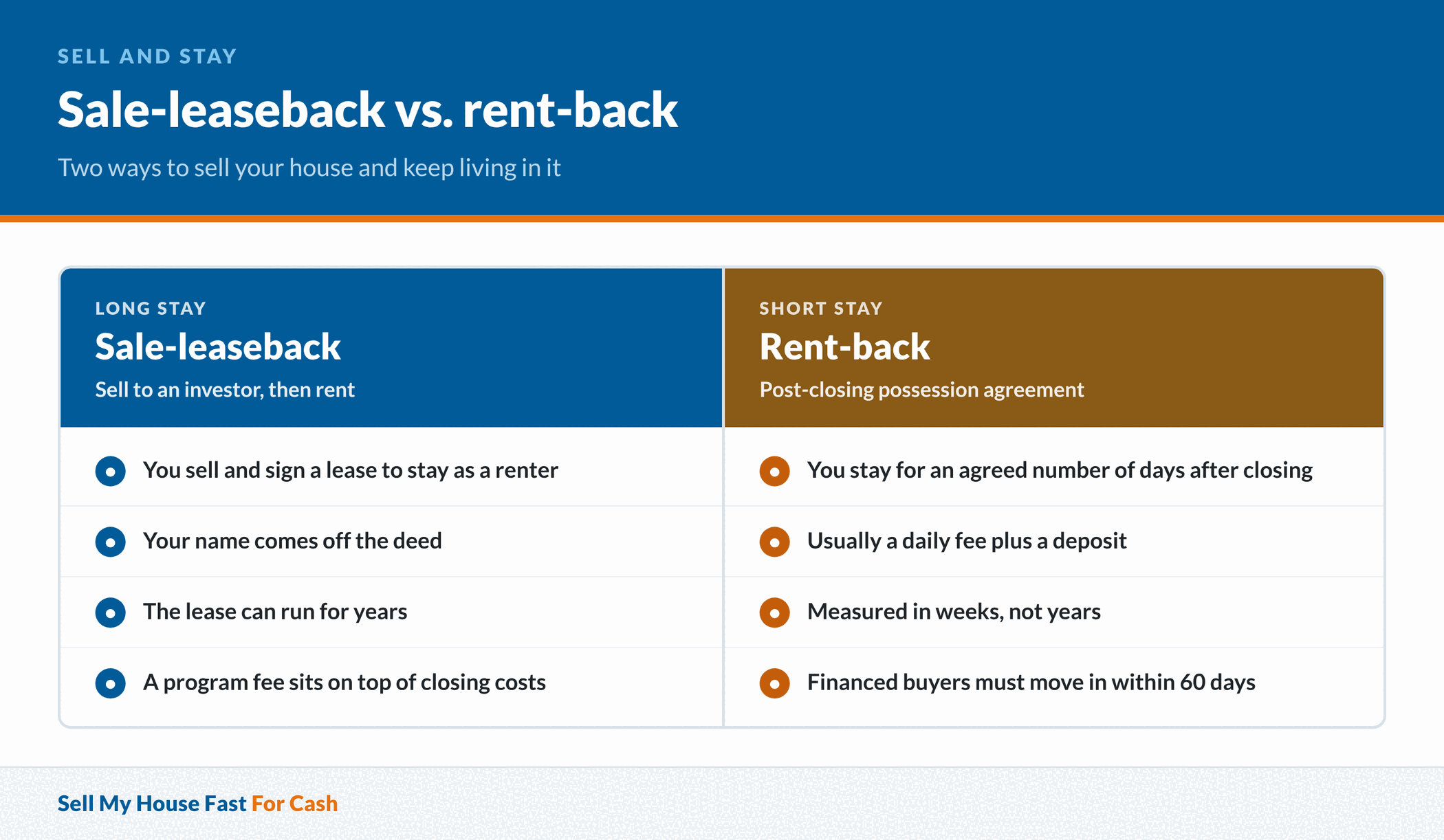
The mechanics fit in one breath. You sell the home to an investor, collect the cash at closing, then sign a lease and keep living there as a renter. Your name comes off the deed and ownership passes to someone else, while the mailbox, the neighbors, and the school district stay right where they were.
People mix this up with a reverse mortgage all the time, and the difference matters. With a reverse mortgage, the lender pays you against your equity and you keep the title. A sale-leaseback hands over ownership instead. There’s no loan, no interest, no credit check on the seller, and no mortgage payment, since the mortgage is gone.
There’s also a short version, a way to sell while living there a few more weeks. A post-closing possession agreement, also called a rent-back, lets you stay for an agreed number of days after closing, usually for a daily fee plus a deposit. That one’s measured in weeks, not years.
Cost deserves a plain answer. Sale-leaseback operators charge a program fee on top of normal closing costs, and Redfin pegs seller closing costs outside of agent pay at 1% to 3% of the sale price. Read that fee line carefully before you sign anything.
What Are the Benefits of Selling and Staying Put?
“Can I get my equity out without moving my mother-in-law twice?”
I hear some version of that at nearly every kitchen-table conversation I have. The honest answer is yes, and for most families I meet that one benefit outweighs the rest. You skip the double move, the storage unit, and two weeks of eating takeout off paper plates.
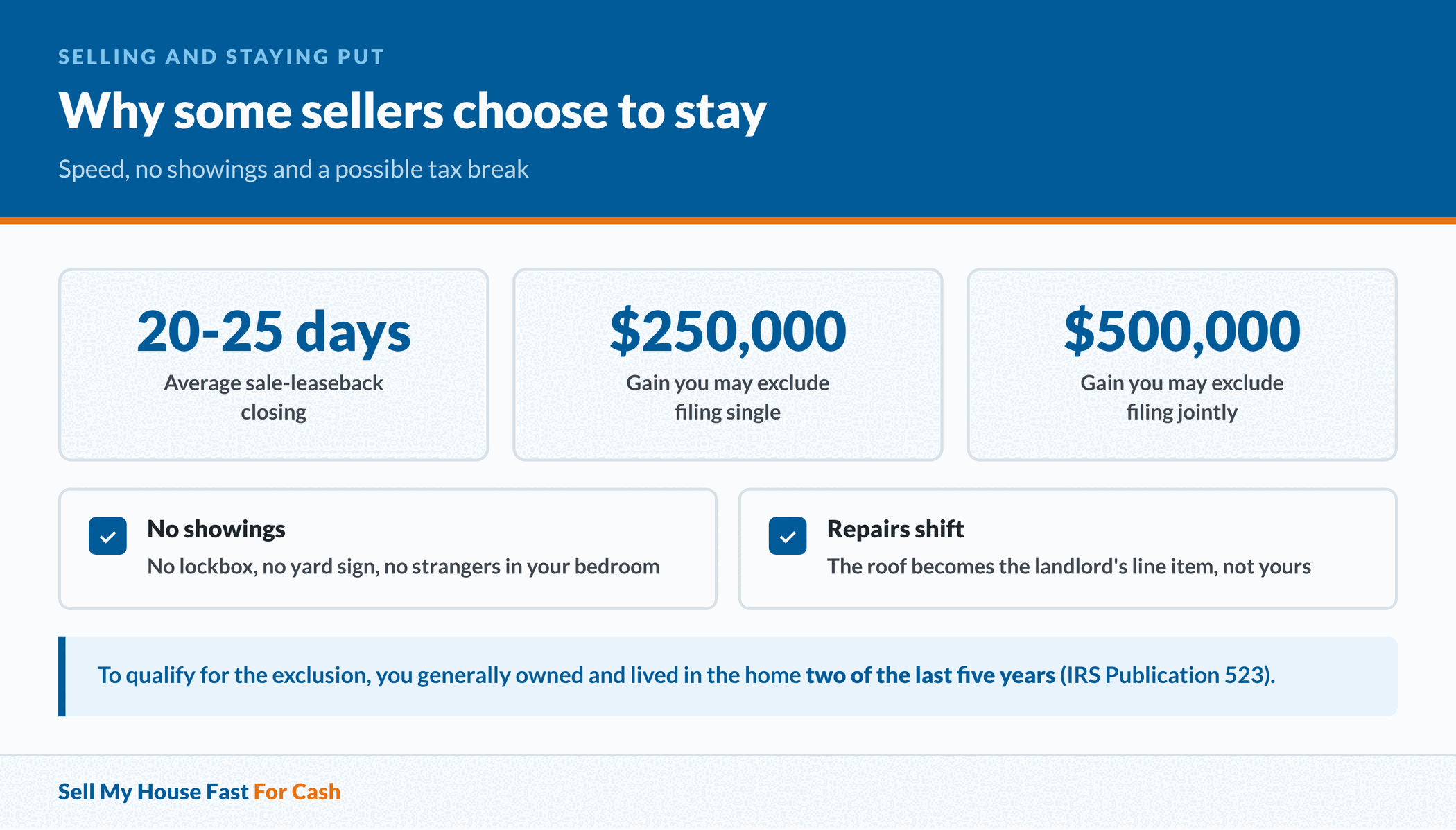
Cash timing is the second draw. Sale-leaseback closings average 20 to 25 days, and sellers with paperwork ready sometimes get close to two weeks. Compare that to a financed buyer who needs an appraisal, an inspection period, and an underwriter in a good mood.
People underrate the no-showings benefit until they’ve lived through the alternative. When you sell while living in the home under a leaseback, nobody tours your bedroom. You won’t have a lockbox, a sign in the yard, or a stranger opening your medicine cabinet.
Repairs come off your plate too. The roof becomes the landlord’s line item instead of yours, and for a retiree on a fixed income, that change alone can reset the monthly budget.
If you want speed and a clean exit without the leaseback layer, a direct buyer is often the cleaner path. Sell My House Fast For Cash is one I’d point people toward for a straightforward as-is offer. Keep in mind that a sale-leaseback is a financial product with a lease attached, while a cash sale is just a sale. Don’t buy the complicated thing if the simple thing solves your problem.
Taxes can swing your way as well. The IRS lets you exclude up to $250,000 of gain, or $500,000 filing jointly, if you meet the eligibility test. You need to have owned the home two of the last five years and lived in it as your main home for two of those five. IRS Publication 523 walks through the edge cases, and a CPA should confirm your numbers.
What Are the Drawbacks of Living in a Home You Just Sold?
Rent-backs have a hard ceiling that your buyer can’t negotiate away. Fannie Mae and Freddie Mac both require a buyer using owner-occupied financing to move in within 60 days of closing. Lenders and agents routinely cap the agreement at 59 days so the buyer can take possession on day 60. Go past that window and the lender may treat the property as an investment, which can mean a higher rate or, rarely, a call on the loan.
So if you want to sell while living there for six more months, a rent-back won’t get you there. A full sale-leaseback will, though you pay for the privilege in a different currency.
That currency is control. You’re a tenant now, with a lease that has an end date, renewal terms, and rules about pets or paint. The person holding the deed gets the final say on all of it, and staying indefinitely isn’t guaranteed.
People also ignore rent when they’re excited about the cash. That lump sum feels enormous on closing day. Twelve monthly rent payments later it feels smaller, and the house you’re renting no longer appreciates for you.
I’ve watched sellers sign leaseback paperwork without reading the rent escalation clause. Please don’t be one of them. Ask what the rent does in year two and year three, in writing, before closing.
Lost appreciation is real math, though the current market softens that argument. Redfin reported the median U.S. home-sale price fell in October 2026 for the first time in more than three years, down 0.1% year over year to $389,601. Owning hasn’t been a guaranteed escalator lately.
How Do You Sell a House While Still Living in It?
I used to tell sellers to deep-clean everything before listing. That’s bad advice for occupied homes, because the house gets lived in again by Thursday and worn-out sellers quit the routine by week three.
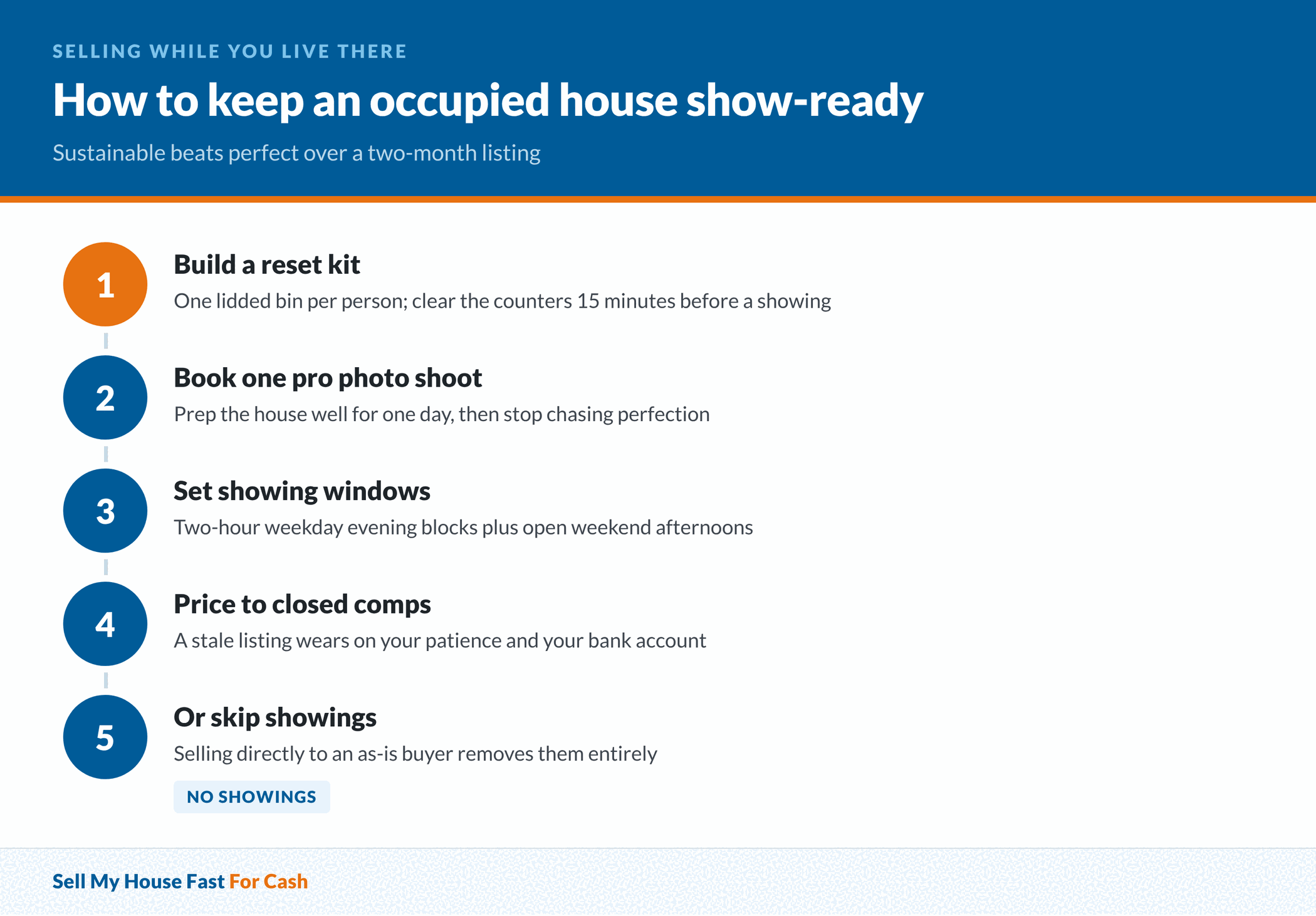
A reset kit works better. Give each person one bin with a lid, stashed in a closet or the trunk. Fifteen minutes before a showing, everything loose goes in the bin and the bin disappears, so you aren’t scrambling every time. Over a two-month listing, something you can keep up beats something perfect.
Photos are the exception. Pay for one professional shoot on one well-prepared day, then stop chasing perfection. Buyers scrolling listings at midnight use those images to decide whether your house makes their Saturday tour.
If you sell while living there, set showing windows and stick to them. Your real estate agent will push back, and sometimes that pushback is right, but a seller who collapses from exhaustion in week four isn’t helping anybody. Two-hour blocks on weekday evenings plus open weekend afternoons cover most serious buyer traffic.
Owners who sell while living there lose the most money on pricing. New listings dropped 7.5% year over year in October 2026, the steepest decline of the year, so you may face less competition than you fear. Price to recent closed comps anyway. A stale listing with people living in it slowly drains your patience and your bank account.
Want to skip the whole performance? Selling directly to a buyer who buys as-is takes showings out of the equation, and you stay in the house on your own terms until closing.
What Does a Sell While Living Timeline Look Like for First-time Sellers?
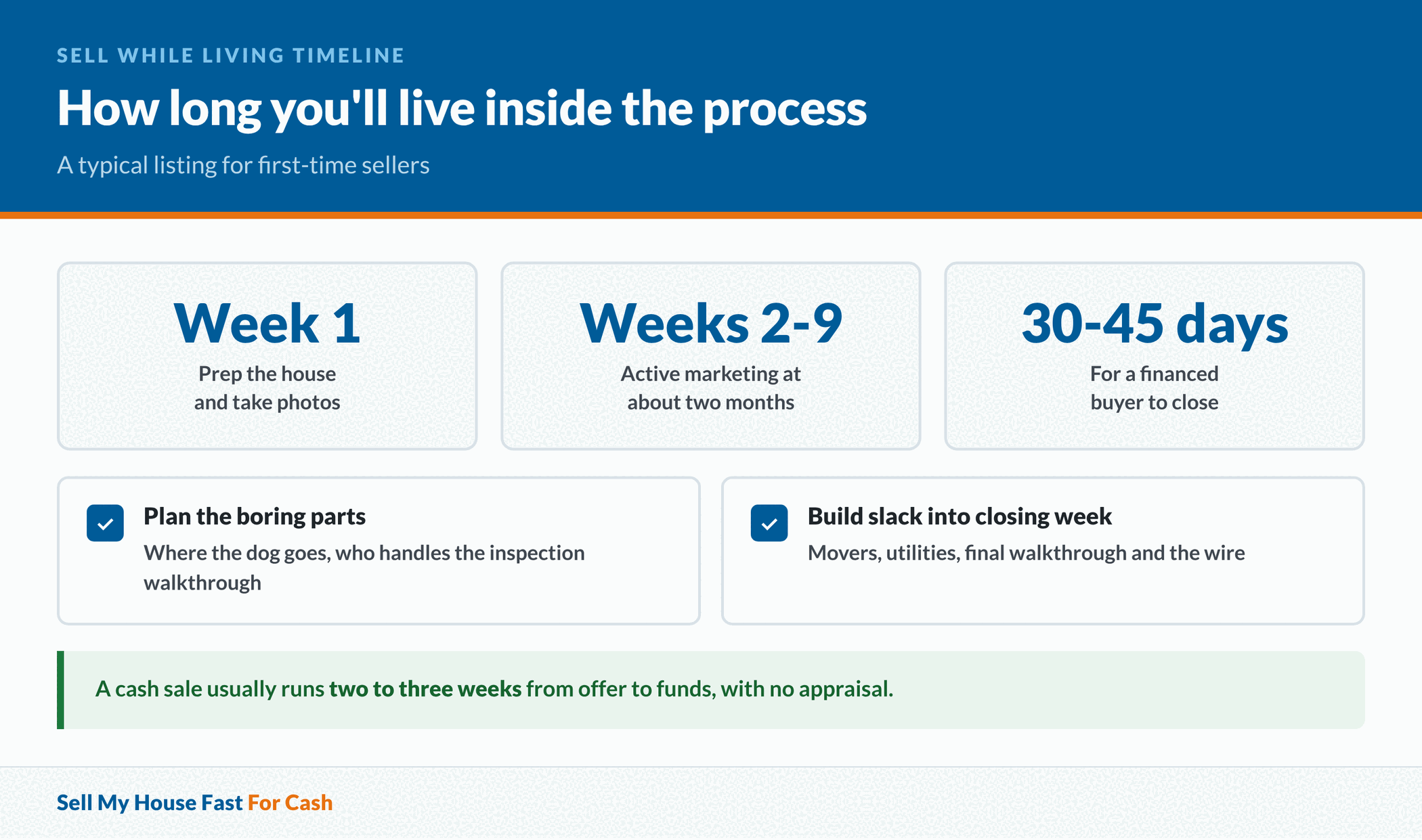
Everybody’s second question is how long this really takes.
Week one goes to prep and photos. Weeks two through nine or so cover active marketing, given that median of roughly two months on market. After that, add 30 to 45 days for a financed buyer to close, assuming the appraisal comes in and underwriting stays quiet.
Call it three to four months of living inside the process. If you sell while living in the home for that stretch, you’ll need a plan for the boring parts. Figure out where the dog goes during showings, who handles the inspection walkthrough, and what happens if your buyer’s loan falls apart in week eleven.
Closing week is its own animal. You’ve got movers, utility transfers, a final walkthrough, and a wire that sometimes lands at 4:45 p.m. on a Friday. Build some slack into that week.
A cash sale shrinks all of it. Two to three weeks from offer to funds is typical, with no appraisal and no lender timeline to work around.
First-time sellers who sell while living there also underestimate the emotional whiplash of that final month. You’ve already moved out in your head, yet you’re still cooking dinner there, and that limbo wears on people more than the showings do. Give yourself permission to feel weird about it.
Mistakes Homeowners Make When Selling While Living There
“If I’m living here anyway, why can’t I just show it myself and save the commission?”
You can, and plenty of people do. Still, a real estate broker earns their cut on negotiation and on filtering out buyers who can’t close. When you sell while living in the home, you’re the least objective person in the room about its condition.
Overpricing tops my list of expensive mistakes. Through late October 2026, 21.5% of listings carried a price drop, up from 20.9% the prior period. Every one of those cuts means somebody started too high and paid for it in time.
Hiding problems comes second. Disclosure requirements vary by state, and your realtor or a local attorney can tell you exactly what yours requires. A dishonest answer on a disclosure form follows you after closing.
Another quiet mistake is refusing to leave during showings. Buyers won’t open a closet with the owner standing in the hallway, so go get coffee.
Many homeowners who sell while living there let the lawn slide in month two. Curb appeal built that first impression, and dropping maintenance halfway through the listing undoes it for every buyer who drives past after the price cut.
Signing a leaseback without an attorney reviewing the lease is the costliest error on this list. A sale document and a lease document can contradict each other, and you want someone whose job is catching that.
Other Sale-leaseback Options for Homeowners Still Living at Home
If we were across the table, I’d tell you a leaseback isn’t the only way to sell while living in your house, and it isn’t always the best one.
Shop more than one program. Several rent-back and leaseback providers operate nationally in 2026, and their fee structures, rent and lease terms differ enough to matter. Some have investors compete on offers. Others make one offer, and that’s the offer.
Seller financing is an underused cousin of this idea. You sell to a buyer, carry a note, and work out your own occupancy terms directly with the person buying. You get more flexibility and more risk, so you’ll want solid legal help drafting it.
A straight cash sale with a short negotiated rent-back covers plenty of situations that people overcomplicate. Thirty to forty-five days of staying put is usually enough runway to find the next place, and in my experience that window rarely needs stretching. Sell My House Fast For Cash can set up this kind of arrangement, and you won’t have a lease escalation clause to worry about.
An heir I worked with in Bend, Oregon got a job transfer the same month probate wrapped. She had five weeks to be out, a 1970s workshop in the detached garage full of her father’s woodworking tools, and no appetite for a traditional listing. We closed, she kept the keys two more weeks to finish sorting the garage, and she made her start date.
Compare any offer against what a listing would net you after commission, repairs, and carrying costs over those two-plus months on market. Sometimes the listing wins. Run the numbers honestly either way.
Frequently Asked Questions
Can You Still Live in Your House While It’s on the Market?
Yes, most owners sell while living there. You’ll handle showings, keep things reasonably tidy, and clear out when buyers tour, but nothing requires you to move out first. The main cost is the daily discipline of staying ready for however long the listing runs.
How Long Can I Stay After Closing on a Rent-back?
Short stays are standard, and the practical ceiling comes from the buyer’s mortgage, not from the buyer personally. Agency-backed loans require the new owner to move in within a set window after closing, and agents usually write the agreement to end a day or two inside that limit. If you need longer than a couple of months, ask about a full sale-leaseback instead.
Will I Owe Taxes If I Sell While Living in the House and Rent It Back?
Possibly not, if you meet the federal home-sale exclusion rules. The ownership and use tests look at your history in the home before the sale, so renting it back afterward doesn’t erase eligibility you’ve already earned. Have a CPA review your specific numbers before you close.
Is a Sale-leaseback the Same as a Reverse Mortgage?
No, and mixing them up leads to bad decisions. A reverse mortgage leaves the deed in your name and adds debt against your equity. A sale-leaseback transfers ownership, pays you in cash, and makes you a tenant with a lease.
Do I Have to Make Repairs to Sell While Living There?
Not if you sell as-is to a direct buyer. Listing on the open market is different, because financed buyers bring inspectors and appraisers who flag deferred maintenance. Before you hire anyone, weigh the repair quote against what the fix realistically adds to your sale price.
What Happens If My Lease Ends and I’m Not Ready to Move?
Ask that question before closing, not after. Good leaseback agreements spell out renewal terms, notice periods, and any rent increase schedule in writing. If a program won’t put renewal language in the contract, treat that as your answer.
Selling While You Live There in the Seattle Area
Living in a house through a long listing gets harder when buyers can afford to wait. In Washington, the 30-year mortgage rate averaged 7.33% in October 2026, up from 6.86% in September, according to the Washington Center for Real Estate Research. Higher rates tend to slow buyer traffic, so showings can drag on. If you’d rather skip that stretch, our cash home buyers in Seattle can buy your house while you’re still in it. We also buy houses in Everett, Tacoma and Kent.
Ask Us About Selling Without Moving Out First
Maybe you’re weighing a sale-leaseback against a straight cash sale, or you just want someone to look at your numbers without a pitch attached. Either way, we’re glad to talk it through. Ask whatever you want, take the information, and decide on your own timeline. There’s no pressure and no obligation.
Contact us with a few details about your move, or use the form below.
Helpful Blog Articles
- Selling a House to a Family Member
- Selling a House With a Child Support Lien
- For Sale By Owner Benefits
- Can You Sell A House As Is Without An Inspection
- How to Find a Realtor in Another State
- Should You Replace Your Roof Before Selling Your House
- How to Avoid Capital Gains Tax When Selling Your House
- How to Sell a House with a Reverse Mortgage
- How to Sell a House While Living in It
- What Are the Most Expensive Home Repairs
