


A few hundred dollars a month in HOA dues doesn’t sound like something that could cost you a house. Then a job ends, a medical bill shows up, two quarters slip past, and the letters start coming from a law firm instead of the board president. I’ve bought houses from people in exactly that spot across Washington, from Spokane Valley cul-de-sacs to condo towers near Lake Union. Yes, an HOA in Washington can foreclose. Getting there takes longer now, and the rules changed this year.
What Is an HOA Lien in Washington?
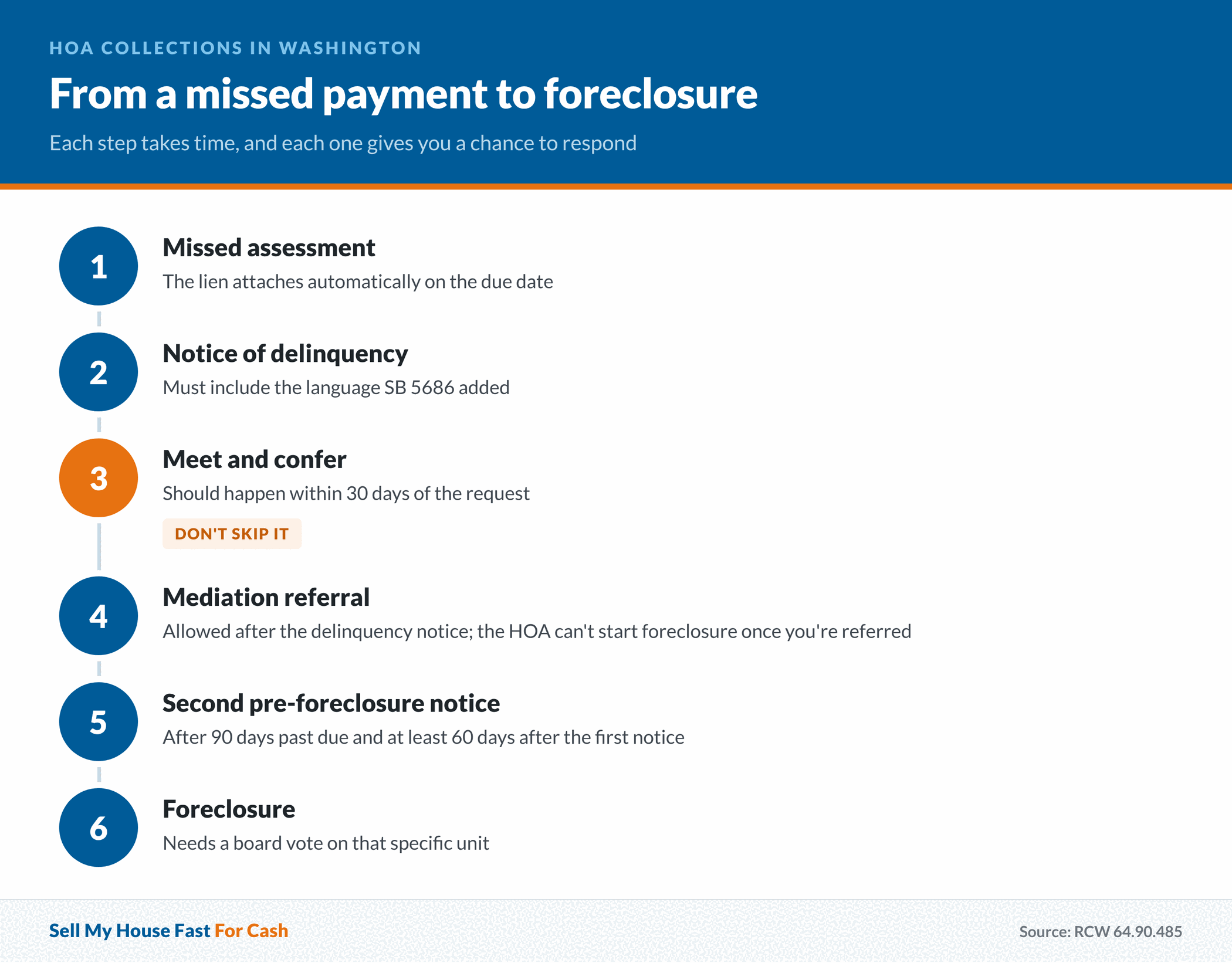
For years I figured an HOA had to go to court and win something before a lien existed. I had it backwards. Under Washington law, unpaid assessments create an automatic lien on the lot, and RCW 64.90.705 says that lien arises on the date the assessment is due. Nobody has to file anything. The debt attaches the moment you miss a payment.
Sellers watching the mailbox for a scary recorded document are often surprised here. Under RCW 64.90.485, the statutory lien exists on its own once assessments go unpaid, so the lien is already there before any notice shows up. Recording a notice just makes the HOA claim visible to title companies. It isn’t what creates the obligation.
Fines and assessments aren’t the same animal, either. Assessments are the dues every owner pays to keep the community running. Fines are penalties for breaking a rule, and in Washington the lien and foreclosure powers of an association center on unpaid assessments. So your neighbor who got cited for a boat in the driveway sits in a different legal category than the owner who quit paying dues entirely.
Washington assigns the debt two ways at once. Assessments are the owner’s personal obligation, and they also become a lien on the unit once due. That association lien carries statutory priority, including limited priority over prior mortgages for a capped amount. You can’t walk away from the balance by walking away from the property.
Last year a widow in Marysville called me about her late husband’s place. Thirty years of belongings were stacked to the ceiling, and a 1970s travel trailer sat rotting in the side yard. Her siblings wanted a clean exit with no cleanup, while the HOA balance kept growing quietly the whole time she was grieving.
What Washington Laws Govern HOA Foreclosures
“My community is older than these new rules, so none of that applies to me.” I hear some version of that all the time, and it isn’t true anymore. Chapter 64.38 RCW governed communities created before July 1, 2018, and Chapter 64.90 RCW governed those created on or after that date. As of January 1, 2026, ten WUCIOA sections apply to pre-July 2018 communities under RCW 64.90.365(1). That old dividing line is fading fast.
If you’re a Washington homeowner, focus on the collections section. You can read the whole chapter on the Washington State Legislature’s site, though it’s slow reading.
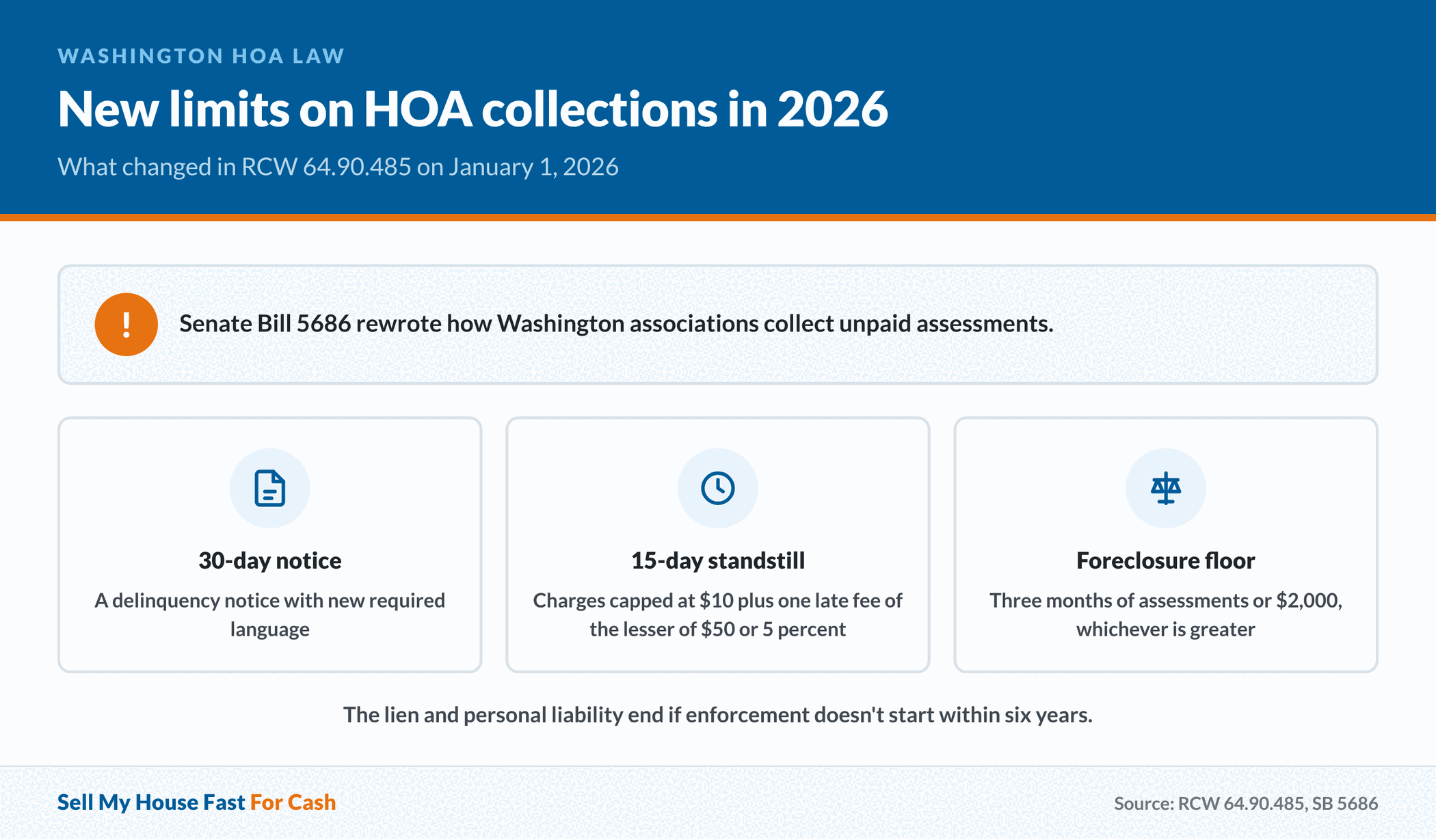
January 1, 2026 brought rewritten collections rules in RCW 64.90.485. You now get a 30-day delinquency notice and a 15-day standstill that caps charges at $10 plus one late fee (the lesser of $50 or 5 percent). There’s also a foreclosure floor. A real cap exists on what can pile up. Before these changes, an unpaid HOA balance in Washington could balloon with administrative charges stacked on top of the actual dues.
Senate Bill 5686 drove much of this. It lets unit owners contact a housing counselor when they’re delinquent or heading that way. It also sets up a process for the owner and association to meet and confer. From there, a housing counselor or attorney can refer them to the Department of Commerce foreclosure mediation program, and both sessions can happen by phone or video call. The enrolled bill text spells out the notice language associations must now use.
One more guardrail matters in Washington. Both the lien and your personal liability are wiped out unless enforcement proceedings start within six years after the full amount comes due.
How HOA Collections Escalate From Late Notice to Foreclosure in Washington
A Kent townhome owner missed two quarterly payments during a layoff. Eleven months later, she sat at her kitchen table reading a mediation referral notice, and she still owned her home.
Most Washington homeowners live in that gap between panic and reality. The HOA escalation ladder has rungs, and climbing each one takes time.
It all starts with the delinquency notice. Section 14 of SB 5686 amended RCW 64.90.485 to require extra language on every notice of delinquency for past due assessments. It also bars an HOA from commencing a foreclosure action if the owner was referred to mediation. A referral freezes the whole thing.
The meet and confer session should happen within 30 days of the request, or later if both sides agree. If the owner refuses to show up after it’s scheduled, the housing counselor or attorney can’t refer the matter to mediation. Skipping the meeting is the single worst move a Washington homeowner with HOA debt can make. You’d be giving up the strongest pause button the statute offers.
Timing on the mediation referral is specific. For association foreclosures under RCW 64.90.485, a referral can come any time after a notice of delinquency has gone out, but no later than a few weeks before the sale date.
You’ll also face a second notice. Washington law requires a second pre-foreclosure notice once you’re 90 days past the assessment due date, and no sooner than 60 days after the first notice. Add it all up and the pre-foreclosure phase in a Washington HOA case runs months, not weeks. Ignoring it still isn’t an option, but you do have room to act if you use it.
Can an HOA Take Your House in Washington?
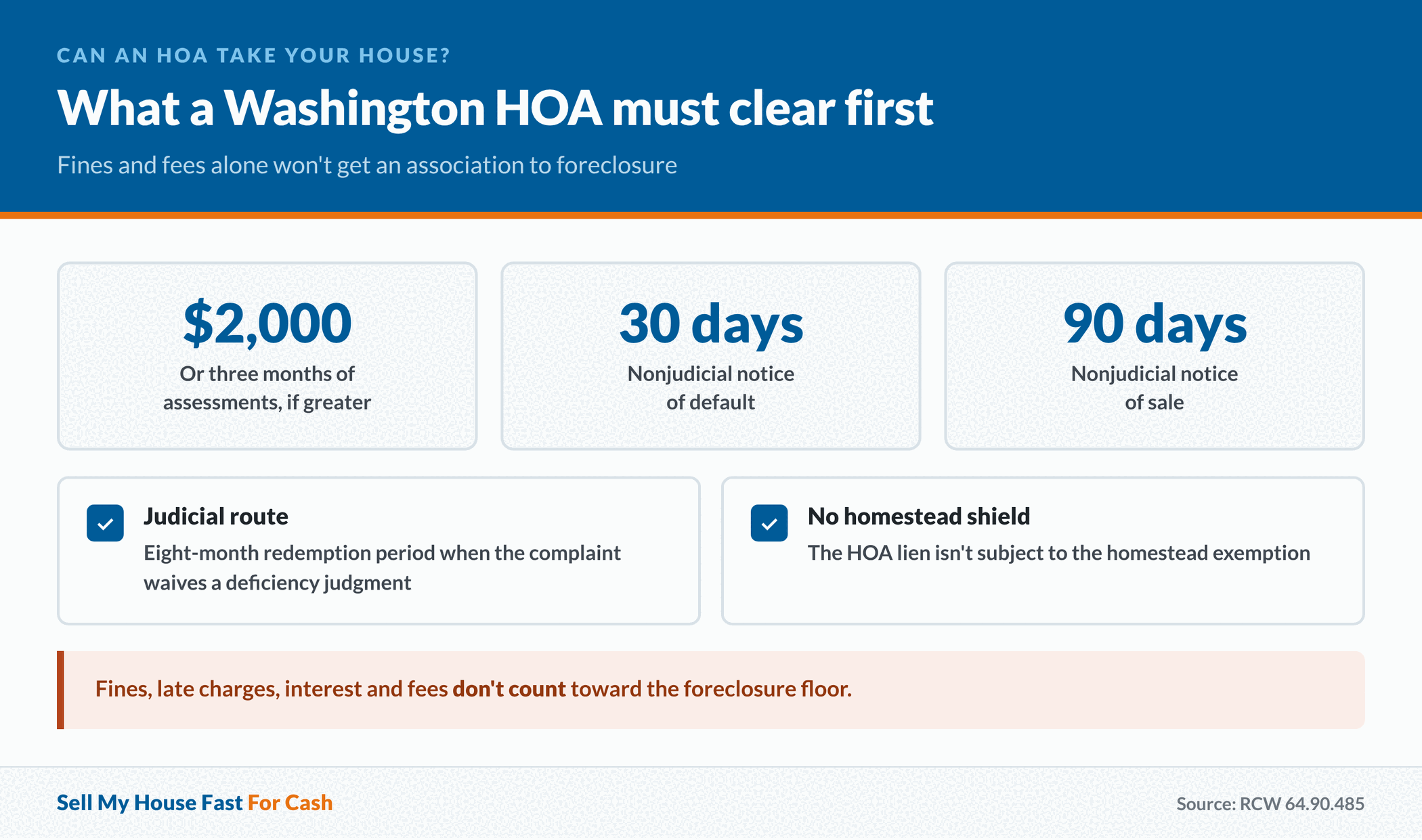
If we were sitting at your table over coffee, I’d say this. An HOA in Washington can take your house, but the statute makes it hard, and the balance has to be real. Under RCW 64.90.485, the association can’t start a lien foreclosure unless the owner owes the greater of three months or more of assessments, or $2,000 in assessments. Fines, late charges, interest, and fees don’t count toward that floor. Only regular assessments do.
A pile of landscaping fines, on its own, won’t get a Washington HOA to the courthouse.
There’s a waiting period too. State law requires that a set amount of time pass after the minimum foreclosure amount has accrued. The board has to approve foreclosure against that specific unit, and every step of collection, foreclosure, and sale must be commercially reasonable. A board can’t hand the decision to a management company and look away.
Washington offers two routes. Nonjudicial foreclosure requires a 30-day notice of default and a 90-day notice of sale. Judicial foreclosure goes through the courts instead. If the complaint in a judicial foreclosure expressly waives any right to a deficiency judgment, the redemption period is eight months.
Most Washington homeowners count on homestead protection, and it won’t help here. The HOA lien is not subject to the homestead exemption. That one line catches people who’ve been told their equity can’t be touched.
I keep seeing the same thing play out. The owners who lose the house usually aren’t the ones with the biggest balances. They’re the ones who stopped opening mail, because every protection in this statute kicks in through a response, and silence waives most of them.
What Happens to an HOA Lien When You Sell or Refinance in Washington
A Bremerton seller got a cash offer she loved. Then title came back showing four years of HOA arrears plus attorney fees nobody had told her about. The sale still closed, though her net dropped by more than she’d set aside for a new roof on her next place.
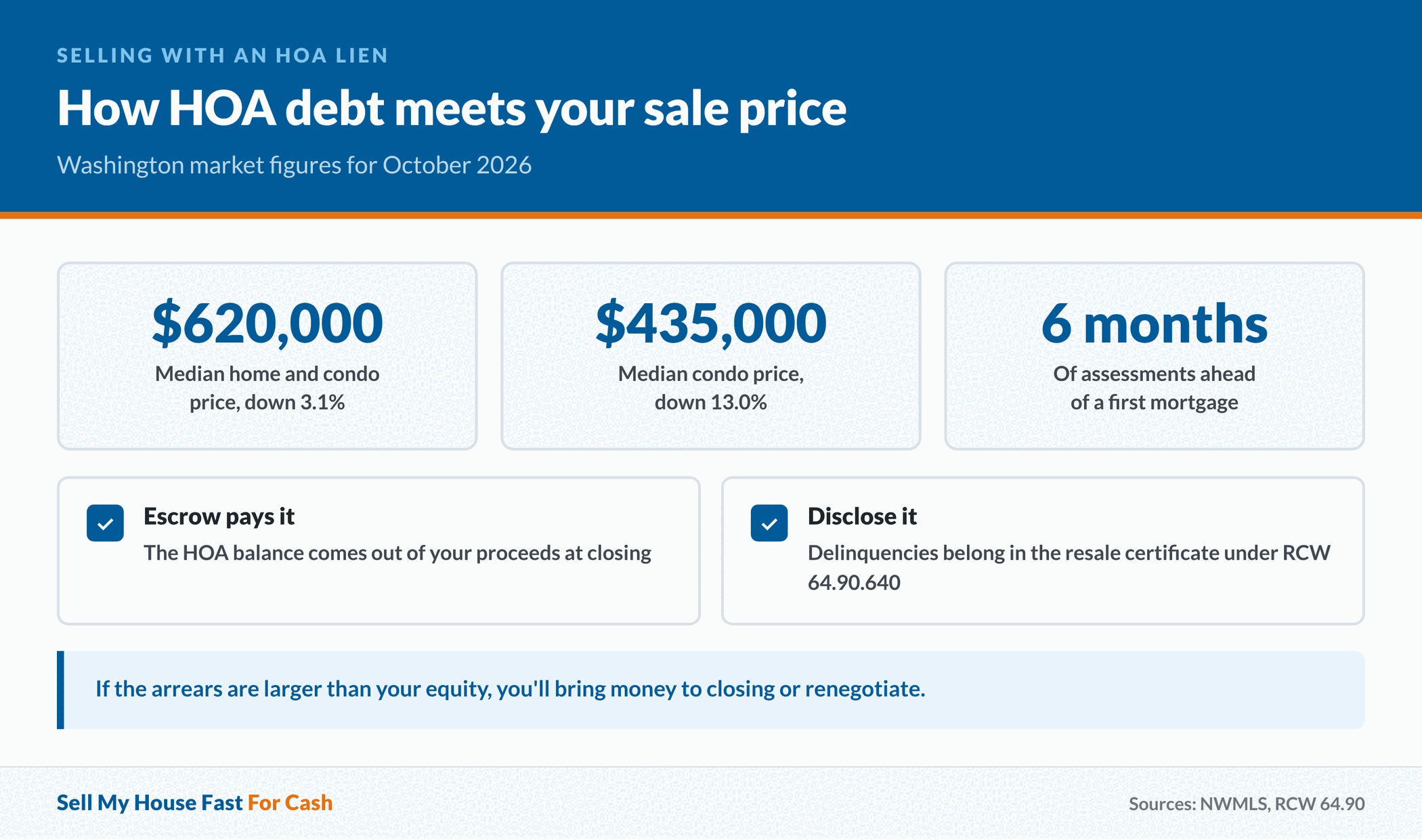
HOA debt doesn’t quietly vanish at closing in Washington. Escrow pays it from your proceeds. If your equity can’t cover it, you’ll either bring money to the table or renegotiate the price.
Washington’s priority rules make refinancing messier. In a foreclosure, the HOA claim for up to six months of unpaid assessments gets paid before the first mortgage lender sees a dime. Foreclosure costs and reasonable attorney fees are added on top, capped at the lesser of the six-month assessment amount or a set limit. Lenders price that risk in, and some just say no.
Your cushion often depends on the market. The median sales price for Washington homes and condos sold in October 2026 was $620,000, down 3.1 percent from October 2025. Condo owners have it rougher, since the median condo price fell 13.0 percent to $435,000 that same month. Falling condo values plus rising assessments make a hard mix for anyone carrying HOA arrears in a Seattle or Tacoma building.
Washington doesn’t treat disclosure as optional. Outstanding delinquencies, active mediation referrals, and pending foreclosure proceedings are all material to resale certificate disclosures under RCW 64.90.640. If you hide the balance from a buyer, it’ll surface at escrow anyway.
When the arrears outrun your equity, a direct sale sometimes works better than a listing. Teams like Sell My House Fast For Cash buy with the HOA payoff built into the offer, so you aren’t fronting repair money just to get listed.
How Washington Homeowners Can Stop an HOA Lien or Foreclosure
Call the HOA board, offer to catch up, and call it solved. That’s the plan most Washington owners start with. It falls apart once a collection attorney is involved, because the attorney’s fee clock keeps running and the HOA often can’t waive it on its own.
Start earlier than feels necessary. Washington owners in common interest communities can contact a housing counselor when they’re delinquent, or when they think they might fall behind on association assessments. You don’t have to wait for a notice. The Department of Commerce runs the program side of this, and Commerce also had to build an online resource center covering housing counseling, the meet and confer process, and foreclosure mediation.
Each party pays its own attorney fees during meet and confer and mediation.
I’ll take a mild stance on payment plans: take one even if the terms feel steep. An HOA board in Washington that accepts a plan has a weak foreclosure case as long as you keep paying. Miss a single plan payment, though, and everything often restarts.
Selling is a legitimate exit, not a defeat. Statewide conditions in October 2026 were balanced rather than brutal. Homes that sold during the rolling 90-day period through early October 2026 took a median of 29 days to go pending or close, and sellers got 98.4 percent of list price on average. Add a 30-day escrow to that and you’re still inside the pre-foreclosure window most Washington HOA cases allow, as long as you move when the first notice lands instead of the third.
Can you fix everything yourself? Now and then. A Puyallup owner I worked with found out her HOA had been billing her for a special assessment that was never properly adopted.
What HOA Boards in Washington Should Know Before Filing a Lien
Get the procedure wrong and your association pays attorney fees twice, once to file and again to defend the owner’s challenge. Washington courts don’t forgive sloppy collections.
Board members face a bright-line rule. They, their immediate family, and their affiliates may not bid on or buy a unit at the association’s foreclosure sale. I’ve watched that rule save boards from themselves.
Notice and a hearing always come before fines. An association must give notice and a chance to be heard under RCW 64.38.020 or RCW 64.90.405 before it imposes most fines. Any fine schedule has to be adopted in advance and shared with community owners. Washington boards that make up penalties mid-dispute end up losing them.
Plenty of boards underestimate reserve studies. An HOA that underfunds reserves for a decade and then hits owners with a surprise special assessment creates its own delinquency problem. A few Spokane and Vancouver associations I’ve worked with learned that the expensive way.
Fee caps now bind the association, not just the collector. SB 5686 caps collection fees, requires meet-and-confer before HOA foreclosure, and freezes foreclosure proceedings during active mediation. I’ve seen boards that haven’t touched their delinquency letter template since 2024, and they’re mailing noncompliant notices right now. An owner’s lawyer will spot that defect quickly.
One practical note for Washington boards: your fastest recovery usually isn’t foreclosure. It’s a cooperative sale. When an owner sells, escrow clears the HOA balance in full, the unit gets a paying neighbor, and the association spends nothing on litigation.
A homeowner out in Port Orchard got a kitchen remodel estimate one Tuesday that ran higher than the kitchen would ever add to her sale price. She was already two years behind on dues. She stopped trying to fix it, sold the place as it stood, and cleared the HOA lien at closing with money left over. Not every story ends that way, but plenty do.
Frequently Asked Questions
Can an HOA Take Your House?
In Washington, yes, though the association has to clear several statutory hurdles first. It needs a qualifying unpaid assessment balance, the required waiting period, proper notices, and a board vote on that specific unit. An HOA cannot foreclose over rule violations alone. Answering the first delinquency notice from your HOA is the cheapest move you’ll ever make.
What Is the Average HOA Fee in Washington?
Washington’s average monthly HOA fee sits around $326, based on about 4,000 fee reports in data updated in October 2026. Single-family homes and suburban townhomes usually run lower. Urban condominiums in Seattle and Bellevue average $450 to $900 or more per month, and older buildings with elevators, cladding repairs, or thin reserves tend to cost the most.
Can an HOA Foreclose on a Home in Washington State?
An association can pursue either a judicial or nonjudicial foreclosure of its assessment lien, and Washington law sets a minimum delinquency before either route opens. Mediation rights added this year can pause the whole process. Your county clerk’s office can confirm whether anything has been filed against your parcel. A Washington real estate attorney can tell you which statute governs your particular community.
Does Selling My House Clear an HOA Lien in Washington?
Closing on a sale pays the HOA balance out of your proceeds, so the lien comes off the title and the buyer gets clean ownership. If the debt is bigger than your equity, you’d need to bring the difference or work out a payoff reduction with the association before closing. Assessments are also your personal obligation under Washington law, so letting the property go to foreclosure doesn’t end your exposure the way many owners hope.
How Long Do I Have Before My HOA Can Start Foreclosure?
You have longer than the panic in that first letter suggests. Between the delinquency notice, the standstill period, the second pre-foreclosure notice, and any meet-and-confer or mediation referral, a Washington association usually spends several months getting to the starting line. Use that window to set up a payment plan, challenge an improper charge, or sell on your own terms instead of someone else’s.
HOA Debt and Selling in the Seattle Area
Timing matters when an HOA balance keeps growing and you’re thinking about selling. Northwest MLS reported that pending sales in its Washington counties fell nearly 18% in October 2026 compared with a year earlier. Fewer buyers going under contract can mean a longer wait on the open market. We buy houses from homeowners across Washington, and the HOA payoff comes out of the sale at closing.
Talk to Us About Your HOA Balance
If you’re sitting on an HOA balance you can’t catch up on and would rather talk than keep guessing, reach out. I’m happy to look at your numbers and tell you honestly whether listing or a direct sale makes more sense. If a housing counselor is the better first call, I’ll point you there. There’s no pressure or obligation, and no hard feelings if you decide to handle it yourself.
Contact our team to get started, or send your details through the form below.
Helpful Washington Blog Articles
- Delinquent HOA Dues In Washington
- Best Time To Sell A House In Washington
- How to Sell a House with Title Issues in Washington
- Refinance A House After Divorce in Washington
- How to Sell a Condemned House in Washington
- Can the Seller Back Out of a Contract?
- Can You Sell a House With Mold in Washington
- How to File a Quitclaim Deed in Washington
- How to Do Sale by Owner in Washington
- Can an HOA Take Your House in Washington